This week at Try Hard Studios - July 17, 2026
I have a friend who was an English major before he went to law school. One of his stories from college is about having to write endless papers, which... sounds miserable to me. Everyone would read the same book, and most people would write from the perspective of "here's what the book said." Which is fine. And probably expected.
My friend's approach was more clever. His papers had two parts: here's what the author set out to do, and here's what the author actually did instead, if inadvertently. So instead of writing, "Here's my analysis of Little Women," he'd write, "Louisa May Alcott set out to write a subversively feminist novel, but Little Women actually subjugates women by reinforcing Victorian cultural norms, and should therefore be discarded."
Is that reading correct? Doesn't matter. It's a far more interesting way to analyze a piece of writing because it measures the gap between what a writer intended and what they actually produced.
Which brings us to a horrible, horrible article written this week by a tech CEO called "Remember to Not Smile." The article itself is nonsense, and I'm not going to debate its merits. That's been done endlessly, and it's been found wanting. The more interesting question is the one my friend would ask: what did the author set out to do?
My best good-faith read: the author set out to say that some things are hard, that you have to keep going, and that if everything always feels easy, you're not challenging yourself enough.
Did he accomplish that? Flat out no. If the goal was to inspire people to push themselves, it completely failed. What the article did instead, inadvertently, was paint the culture of his company as a miserable, toxic place to work.
Now to the part that's instructive for the rest of us.
There's a saying: "The purpose of a system is what it does." There's no point claiming a system's purpose is something it consistently fails to do.
The parallel for writing is this: the takeaway from an article is what's taken away. Not what you intended the audience to take away. What they actually took away.
The author later came out and said, "That's not what I meant at all! Here's what I meant." Which, to me, only confirms the article was poorly written. When you write, or speak, or communicate in any form, the takeaway is whatever people take away. Your intention doesn't matter if you don't communicate it clearly. That's a failure of the article, not a failure of the audience.
Some people defended the piece: "The underlying message is good." Maybe it is! But that wasn't the takeaway, and so the article failed. The purpose of an article is what it conveys. If you want your message to land, writing it down isn't enough. You have to write it in a way that makes it land.
The takeaway is what's taken away.
Things I found this week
Just a heads up that each Twitter/X screenshot has a link to the original post if you want to go follow the account.
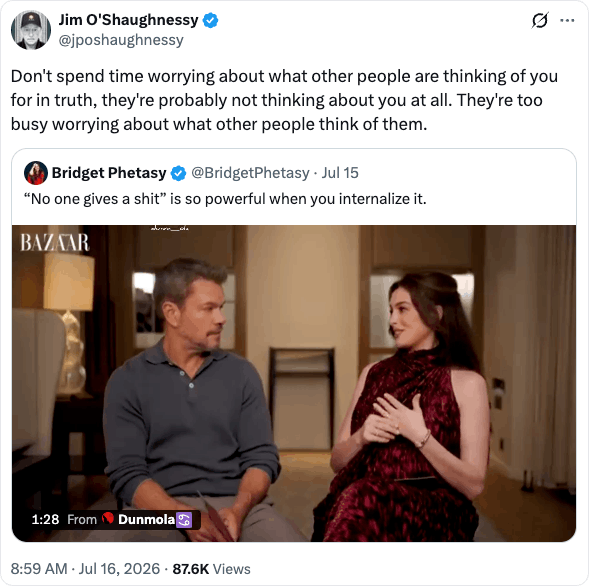
Do not spend time worrying what people are thinking about you because, in all reality, they're spending time worrying what people are thinking about them, not thinking about you at all. And even if they were thinking about you, at the end of your life you're not going to care. You're going to care whether you tried to accomplish the things that were in your heart, not if you looked silly to some people on the internet.
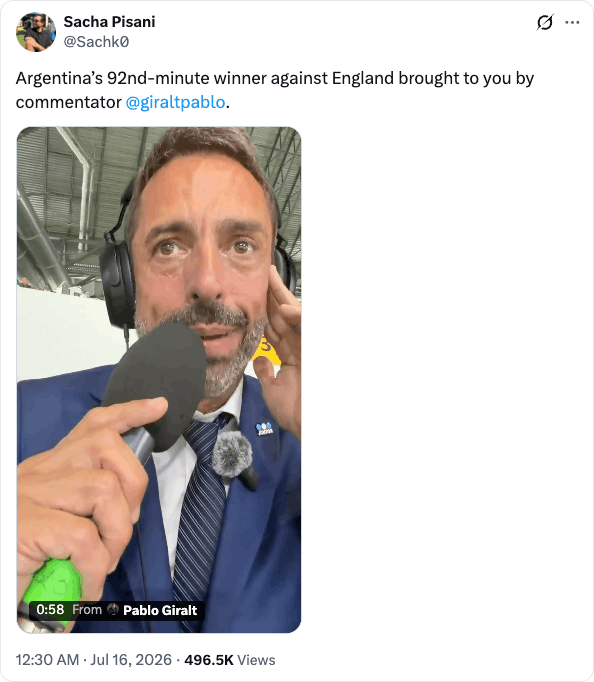
Oh to find something you love as much as this guy loves commentating on Argentina.

Delightful little sounds that are somehow far more pleasing than a regular MP3. I don't fully understand the technology behind it, if I'm being honest, but it's pretty cool that they're programmatic and not actual baked MP3s.

Never doom! Never doom! Are you just going to lay there and bleed or are you going to get up and do something about it?
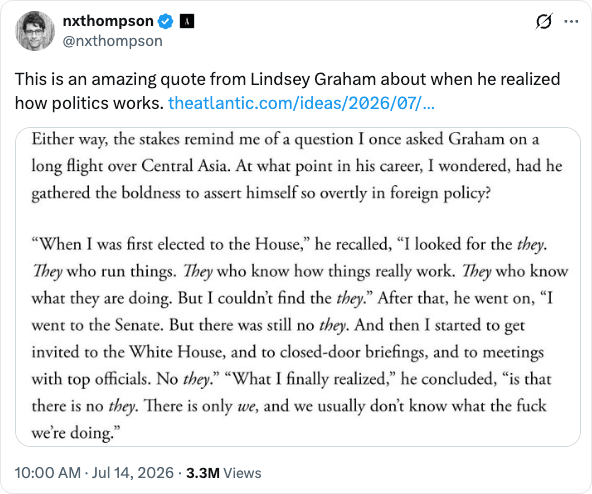
There's no them, there's no they, there's nobody in a secret room with all the power, especially when it comes to your own life. Nobody's coming to save you. This can be terrifying, or it can be invigorating, and in some ways it's both.
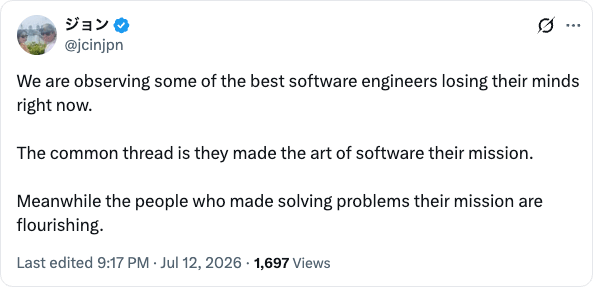
I'm very sensitive to the people who feel like they've lost their way in the AI era, especially developers who feel like a lot of the joy is gone. But I think this is the correct take.
The job has always been to solve problems. In some regards, we were solving problems at a much lower level, and maybe a lot of people found joy in that. I know that I certainly did.
But I still find joy in solving problems every single day, and I still do it with code. I just don't handwrite it anymore.
If you’ve been enjoying the newsletter and think a friend may enjoy reading it each week too, please forward it to them! They can sign up to receive it weekly here: https://aaronfrancis.com/newsletter.
That’s it for this week! I enjoy reading all of your replies, so if you see something interesting or just have a thought you want to share, please hit reply and let me know.
Talk soon,
Aaron